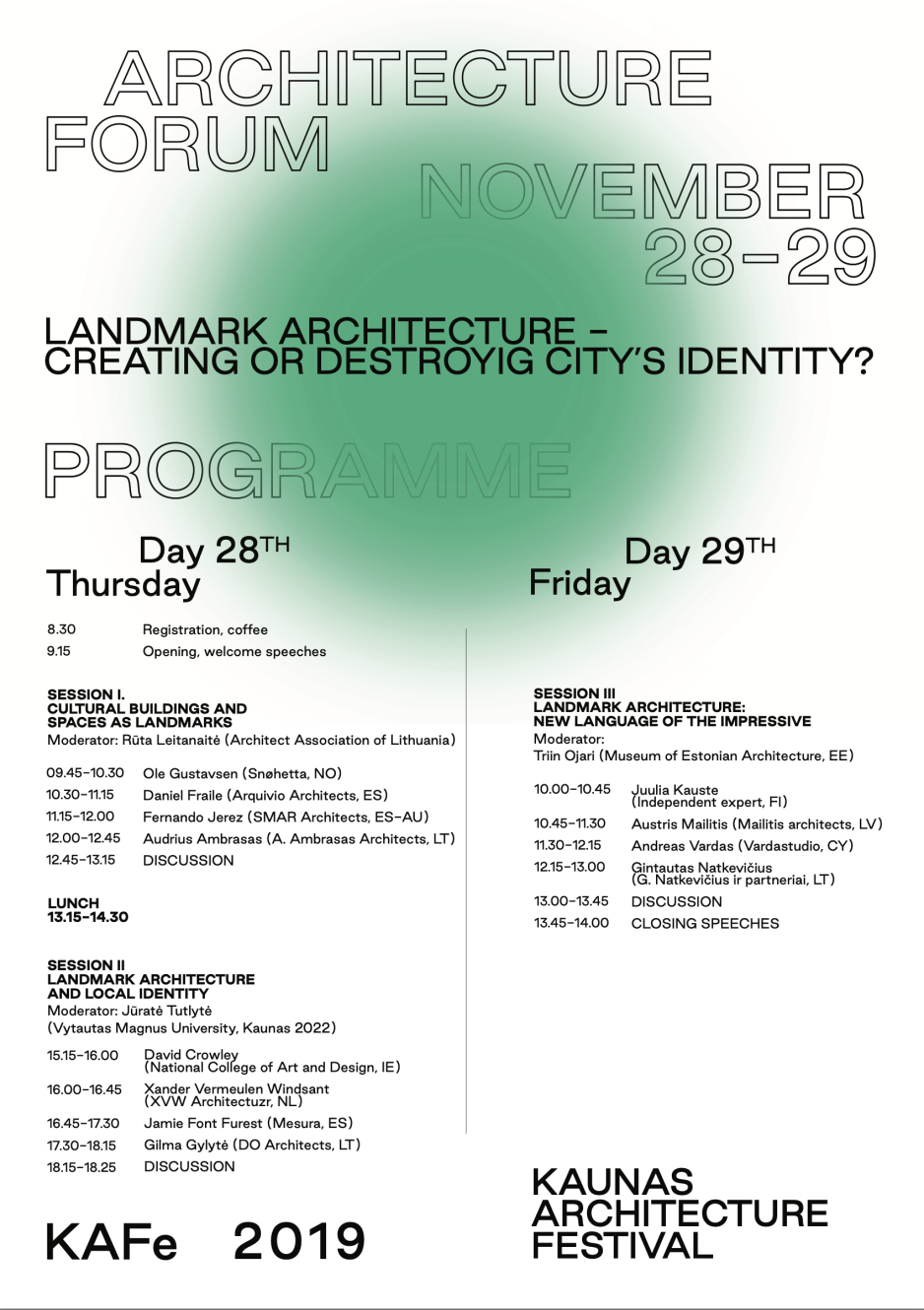
Kaunas Architecture Festival (KAFe) 2019: Landmark Architecture – creating or destroying city’s identity?

Kaunas Architecture Festival (KAFe) is an international project, taking place in Kaunas every 3 years and inviting townspeople, architectural professionals and guests of the town to take part in an almost 2 month long experiment promoting architecture, creativity and education, which emphasizes the impact that architecture has on our lives, its importance to creation of public well-being and harmonious environment. Reaction to the projects being implemented in Vilnius and Kaunas (Missionary gardens, development of St. Jacob’s hospital, Reconstruction of Vienybės Square, renovation of Ąžuolynas park, etc.) shows that the public is increasingly interested and willing to participate in urban development processes, therefore public events, that analyse architectural issues, are very much needed and receive a lot of attention.
KAFe festivals, which took place in 2013 and 2016, have received a lot of attention and appreciation not only from professionals, but also from the public, they had over 50 different events related to architecture and more than 10 publications published.
The topic of this Kaunas Architecture Festival is Landmark Architecture – creating or destroying city’s identity?
Many cities around the world are competing to have landmark buildings, created by world-renowned architects, despite the fact that such objects are often built without taking into account the existing urban structure or by strongly altering the historical environment. Doubts are often expressed in public debates whether such buildings truly create the identity and uniqueness of the city, or perhaps the opposite – it is destroyed. Are buildings of impressive shapes and structure, which are large, but dissonant with the environment, what today’s society awaits and expects from architects and their clients? Can landmark architecture be something other than glass towers, oriented only to international names, tourists and business interests? Perhaps exclusive architecture should emphasize the uniqueness of the location and serve as the true city sign, at the same time harmoniously complementing the existing urban structures. The focus of KAFe 2019 will particularly be on search and development of objects of different landmark architecture and urban expression.
TEAM:
ORGANIZER: Architects Association of Lithuania Kaunas Branch
Curator general: Gintaras Balčytis
Curator: Rasa Chmieliauskaitė
Coordinators: Tautvydas Urbelis
Design: Eglė Simonavičiūtė
BRITANIKA project

The opening event of the Kaunas Architecture Festival will take place in one of the tallest buildings in Kaunas centre – the hotel “Britanika”. During the event, for the first time in thirty years, it will be possible to legally see the panorama of Kaunas city from the roof of this building.
This year, the Kaunas Architecture Festival invites to discuss the landmark buildings of the town, therefore the opening event of the festival is planned in one of the most important buildings of Kaunas city centre – the abandoned thirteen-storey hotel “Britanika”. The unfinished building, which has been standing for more than thirty years, has become part of the panorama of Kaunas, but at the same time it is undetectable and visiting it is illegal. During the festival we will invite the public to visit the forbidden building and discover new points of Kaunas by climbing on its roof.
TEAM:
Paulius Vaitiekūnas, Gintaras Balčytis, Rasa Chmieliauskaitė, Tautvydas Urbelis, Jautra Bernotaitė, Neringa Sobeščukaitė, Andrius Ropolas, Andrius Pukis.

Can “iconic” architecture be correct and non-dominant? What is in its focus: the social needs of the townspeople or the interests of businesses and tourists? Are buildings built by the same architecture stars suitable for different cities? What is the enduring value of such architecture? We invite you to look for the “iconic” nature not only in form of architecture. Exceptional architecture emphasizes the uniqueness of the place, harmoniously complements the existing urban fabric, giving priority to social and cultural content.